
If you want to understand where Boston housing development is heading over the next five years, I think the best place to start is not with policy, subsidies, or project types. It is with the fundamentals of the residential market.
Greater Boston is still a high-demand housing market. The region continues to attract residents because of its concentration of jobs, universities, healthcare systems, transit access, and long-term economic resilience. That demand has not gone away. What has changed is the growing gap between what the market needs and what the housing pipeline is consistently able to deliver. The 2025 Greater Boston Housing Report Card frames this clearly: it is an annual regional look at housing supply, home prices, and affordability, and its latest findings show a market where construction has improved, but future supply signals remain weak.
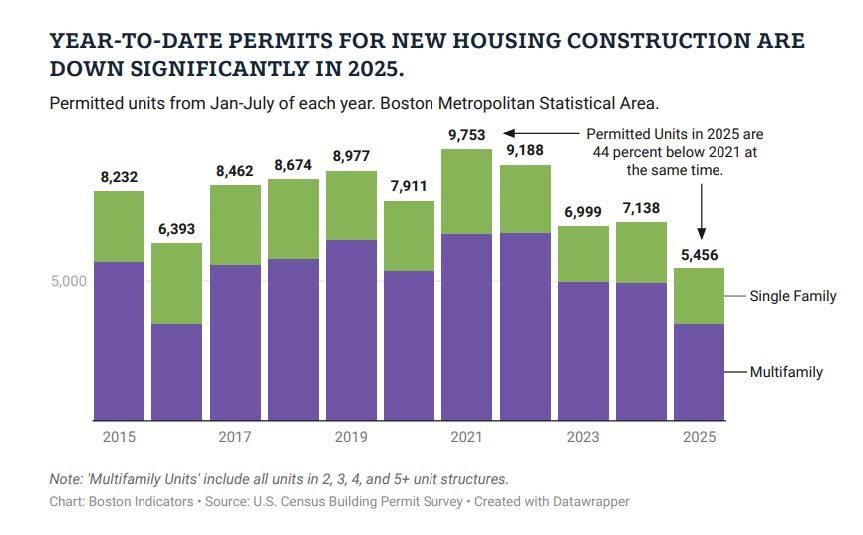
That distinction matters. In any housing market, completions tell you what is landing now, but permits tell you what is likely coming next. In Greater Boston, completions have increased since 2020, but as you can see in the table below, permits have fallen sharply, which suggests the region may be setting itself up for another period where demand stays strong while future inventory struggles to keep pace. The Housing Report Card’s core metrics say Greater Boston added more than 70,000 homes since 2020, but new permits as of mid-2025 were running well below earlier levels.
That is where the affordability issue becomes more than a social concern. It becomes a core development trend.
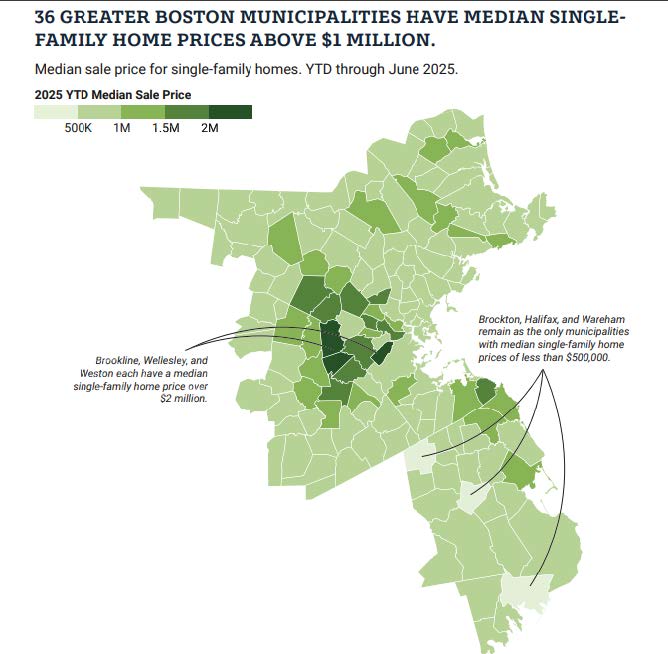
When supply is constrained over time, affordability gaps widen across the market. Entry-level homeownership gets pushed further out of reach. Renters remain renters longer. Households compete harder for smaller pools of available housing. And developers, municipalities, and policymakers all start facing the same question from different angles: what kind of housing can actually get built, financed, approved, and absorbed in this environment?
In Greater Boston, that question increasingly leads back to affordable and mixed-income housing.
Not because market-rate housing is unimportant. It absolutely is. But because affordability is now central to how the region functions. A housing market is not healthy when essential workers, young families, seniors, and moderate-income households are priced out of the same communities where jobs, schools, and transportation are concentrated. Over time, that starts affecting labor markets, economic competitiveness, commuting burdens, and municipal growth patterns. The issue is no longer whether affordability matters. The issue is how large a role it will play in shaping the next development cycle.
That is why I see affordable housing as one of the strongest development themes in Boston for the next five years. It sits at the intersection of market need and public response. Boston’s Housing Strategy explicitly positions mixed-income and affordable housing as one of the main tools for stabilizing the market, alongside transit-oriented development and greener housing delivery. In other words, the city is not treating affordable housing as a side category. It is treating it as part of the broader solution to a structurally imbalanced market.
From a project standpoint, that has major implications. It means the next wave of benchmark deals is likely to be less about pure luxury delivery and more about practical, financeable models that respond to real demand. Mixed-income multifamily. Transit-oriented infill. Public-private partnerships. Gap financing for stalled but entitled projects. Adaptive reuse where the numbers work. Family-sized units in high-opportunity areas. Deeper affordability layered into projects that also make sense from a neighborhood planning and political standpoint.
For developers and investors, this is worth paying attention to now, not later. The most important housing opportunities in Boston may not come only from chasing top-of-market pricing. They may come from understanding where public policy, capital, land use, and unmet demand are starting to align.
That does not mean every affordable housing deal is easy. Quite the opposite. Many are more complex, more layered, and more dependent on execution than conventional market-rate projects. But complexity is often where long-term opportunity lives. And in this market, affordability is becoming less of a niche and more of a central organizing force in development strategy.
So when I look at Greater Boston’s residential market, I do not just see a housing shortage. I see a market signaling where the next frontier of development is headed. Strong demand remains. Future supply is uncertain. Affordability gaps are deep. And because of that, affordable and mixed-income housing look less like a policy side note and more like one of the defining development trends of the next cycle.
 Real Estate Investment Advice
Leave a comment